Development Procedures
~Predominantly in NYS/NYC~
This note will serve as a reference for me when I need a reminder of general and NY-specific planning and development procedures. This will include:
- Very general outline of a typical project timeline from acquisition to final construction
- National Environmental Policy Act (NEPA), State Environmental Quality Review (SEQR) Act & City Environmental Quality Review (CEQR) Act processes
- NYC Uniform Land Use Review Procedure (ULURP)
- coming soon Other (mostly NYS)-specific permits and when their need is triggered
- coming soon Zoning reform and why it is hard/necessary evil
- coming soon (NYC-specific) Project delivery strategies (i.e., delivery method, contract strategy, compensation method, procurement approach)
- coming soon permit matrix
A Basic Project Development Outline
For any given project, a developer will conduct, typically, initial site due diligence & financial analyses to determine if the site should be purchased for the use(s) intended. This often includes:
- a Phase I Environmental Site Assessment prompted by the buyer/lender,
- property surveys & easement checks, more in-depth title searches to determine potential hidden liens, restrictive covenants, or unpaid taxes (leading to additional debt or legal issues),
- zoning analyses to ensure their use is permitted,
- utility access checks, and
- exploring whether development moratoriums or historic preservation/agricultural restrictions apply.
Once purchased, the application process typically begins. This can include the procurement of consultants (i.e., architects, civils, wetland scientists, landscape architects, planners, contractors, etc., etc.).
Often, Environmental Reviews coincide with the permitting process, either/both can be lengthy and tends to be every developer's worst nightmare.
cough, cough cue to me !!!!!!
(we'll get back to this in the next couple of dropdown sections)The design phase of a project will coincide with permitting more often than not to ensure permitted requirements are met, and non-permitted aspects are altered, or a plan for variance(s)/conditioned approval(s)/discretionary approval(s)/waiver(s) is(are) sought. This, along with permitting, will regularly require field visits to obtain accurate, current site condition information.
Once the review is settled and the permits approved, then the developer can begin putting together a bid package for general contractor (GC)/subcontractor procurement. A standard bid package will include:
1. invite to bid (aka a letter with key details like deadlines & contact info),
2. architectural/engineering drawings,
3. specifications of the materials and performance standards,
4. scope of work that details specifically what is and is not included in the contract,
5. timelines and major milestones.
note: according to NYS General Municipal Law § 103, public bids are required for all political subdivisions, purchase contracts in excess of $20,000, and contracts for public work in excess of $35,000.The bid is advertised in the NYS Contract Reporter for GC to review and determine if they'd like to go for the effort. Then, a sealed public bid will be compiled & submitted for a public bid opening/meeting. Once the bids are read aloud at the opening (specifically, the GC name & bid price to retain transparency and to give GCs an idea as to whether they have a shot), the evaluation of which bid to choose will be conducted. This will often occur as a joint effort between the client & the consultant (if there is one). The lowest responsive and responsible bidder or "best value" bidder will be chosen. This process maintains competitiveness and reduces favoritism.
note depending on the nature of the project, public entities will issue an IFB (invitation for bid) as described, or they will issue an RFP (Request for Proposal). IFB's are more strictly defined and the exact needs are specified, whereas RFPs are often when clients have a goal, but need vendor(s) support to propose best methodology, tech, and whatever other solutions (tend to acquire earlier in the process, pre-design even).MOBILIZATIONNNN - well first, usually there is a pre-mobilization meeting with all relevant parties to ensure everyone is on the same page and that the GC has adequately reviewed the drawings & specs. AND the GC will submit and pull the general work/building permits & any other project-specific permits, which actually are pulled by subs with the correct licensing requirements (i.e., plumbing, electrical, HVAC, etc.).
note: In the NE, construction season can be anywhere from late March to late October.
Site preparation and excavation will start to prepare for the build. I think before any ground disturbance occurs, the GC must call "Call Before You Dig" to get someone out to the site to check for underground utility lines/pipes.
During the construction phase, there ought to be routine checks from a construction observer to ensure quality work is being performed. Erosion and sediment control (ESC) reviews are important, if required, when soil disturbance is occurring. I won't go into much more for construction here.
To finish off, the closeout phase (when the project is nearing substantial completion) will require the punch list check. When the GC deems the site done, the post-construction phase begins. This includes the final punch list walk, site cleanup of excess debris and whatever else to ensure property safety/expected completion standards of the client/owner, final inspections, system(s) commissioning and testing, GC demobilization, final payouts, and project handoff to the owners (this is where an "as-built" drawing will be provided for future maintenance, etc.
Environmental Reviews (Fed, State, City)
The United States is a unique one, to say it more nicely. Across the board, all projects that involve federal funding, permits, and land are subject to NEPA reviews. Otherwise, they proceed as required in their respective jurisdiction. For some states (and cities), more stringent reviews are created (State Environmental Policy Acts "SEPA" or City Environmental Policy Acts "CEPA"). These reviews are governed by State Administrative Procedure Acts' (SAPA) rulemaking procedures and are subject to individual state environmental statutes prepared by state legislatures. Approximately 1/3 of all states have state-level environmental reviews.1
New York State and City both have a SEPA and CEPA, which are deemed the NY State Environmental Quality Review (SEQR) and NY City Environmental Quality Review (CEQR) - yes, saying the names out loud is confusing. The City's review is localized and tailored to a more unique build type & zoning bylaw.
note To clarify, if you have a project in NYC that requires a state discretionary permit, license, funding, or approval, it is subject to both CEQR & SEQR.
More details about each level of review are below.
NEPA
NEPA is the federal law governing the disclosure and analysis of the environmental effects of actions that are funded, approved, or directly undertaken by a federal government agency.
SEQR
SEQR regulations are Title 6 NYCRR Part 617. "This Part is adopted pursuant to sections 3-0301(1)(b), (2)(m) and 8-0113 of the Environmental Conservation Law to implement the provisions of the State Environmental Quality Review Act (SEQR)."2
Elevator Pitch(WIP): SEQR is the state's environmental review that is required for all projects proposed in NYS that require a state or local agency's discretionary approval. This is done to ensure consideration of environmental factors and their potential impacts has been made and are assessed specific to the project and its surrounding social and ecological infrastructure. A determination of action type is made for each project. This step enables the reviewers to determine whether the SEQR process will end (Type II) or continue onward (Unlisted/Type I). If continuing, an Environmental Assessment (EA) uncoordinated or coordinated review will commence, which assigns lead agent(s) (LA). The LA will give a project a positive or negative declaration. If positive, the review continues into the Environmental Impact Statement (EIS) phase, which incurs a far more in-depth review and public coordination process. Finding statements will be prepared by each involved agency (IA) (determined in the EA phase) following the submittal of the final EIS & Notice of Completion. Each IA issues an approval or denial of the proposed action.
The Procedure
The SEQR Cookbook and Handbook are both great resources to reference when reviewing the steps that shall be taken to determine whether an action can proceed.
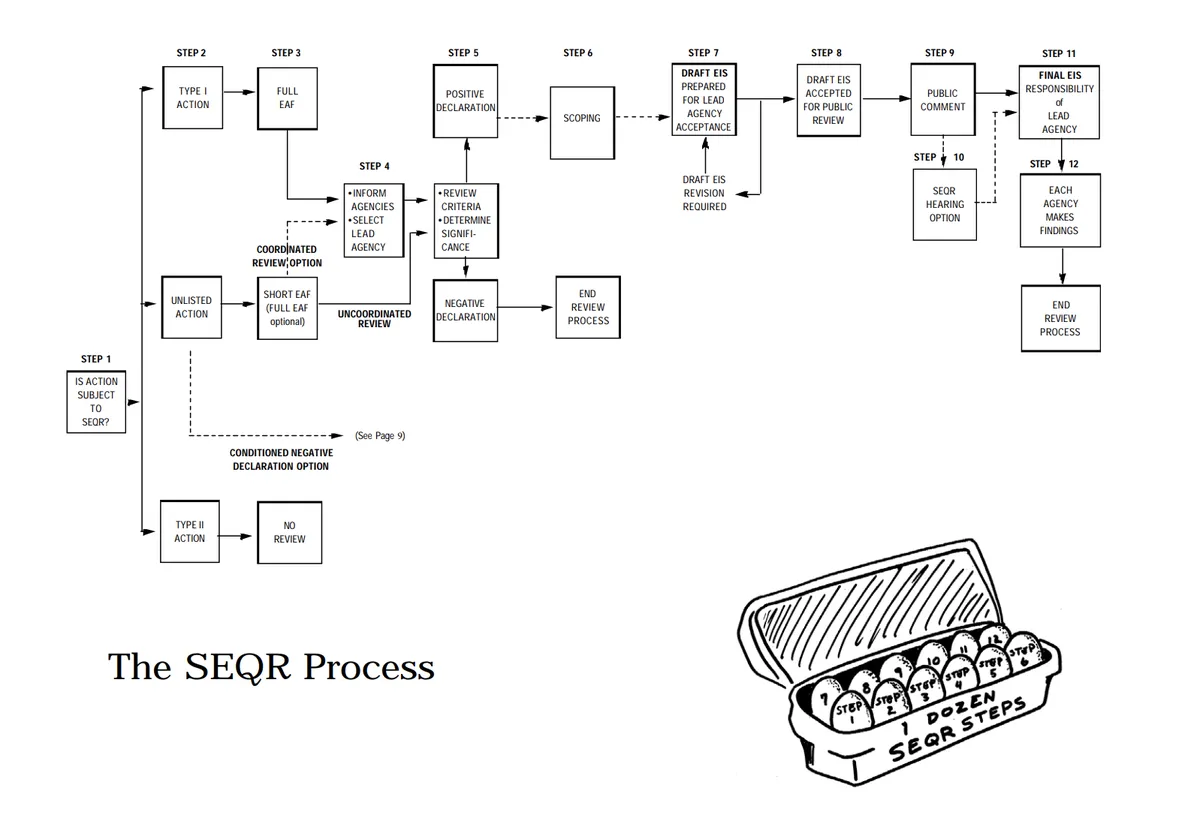
Here is a screengrab of the SEQR Cookbook's flowchart.
Action Types
Type I, Type II, and Unlisted actions are very specific. One must reference 6 CRR-NY 617.4 & .5 for the list of Type I and II actions. If your action does not fall under any of these project types, it is considered an Unlisted action. Recently, in June '26, the New York State Department of Environmental Conservation (NYSDEC) adopted amendments to the regulations (6 NYCRR Part 617) that implement the State Environmental Review Act (SEQR; ECL Article 8). This document issued by the NYSDEC called "Part 617 Express Terms" has the updated changes made to 6 CRR-NY 617.4 & .5 (which I will detail further in the SEQR Recent Reform dropdown section below).\
Review Types
Type II actions do not require further review under SEQR. Type I actions require a coordinated review, starting with the preparation of the Full Environmental Assessment Form (FEAF) Parts 1-3. Unlisted actions do not require coordinated reviews.
Involved agencies (IA) are agencies that has or will have a discretionary decision to make regarding an aspect of the action (see page 62 of the Handbook). IA will be determined for Unlisted actions depending on the review option taken (Type I actions always require this step). There are 3 options:
Uncoordinated review option: (see page 57 of the Handbook) each involved agency (IA) acts as Lead and independently conducts an env. review to determine action significance. If all IA issue a negative declaration (neg dec), a project may proceed. If any issue a positive declaration (pos dec), an EIS must proceed.
Conditioned Neg Dec option: (see page 90 of the Handbook) if an unlisted action is determined by an IA that the potentially significant impact(s) could be eliminated or reduced to a non-significant level through imposed conditions, this option will suffice. A FEAF and coordinated review is required for this option.
Coordinated review option: (see page 56 of the Handbook) all IV must be contacted by the project sponsor to indicate the coordinated review commencement. LA must be established by agreement of agencies within 30 calendar days. Following LA designation, it has 20 calendar days to determine significance once all information is received. For a Neg Dec, a file must be maintained of the project for public access. The determination must also be posted to the Environmental Notice Bulletin (ENB) (by Wednesday @6pm to be posted for the following Wednesday).
The Neg Dec is typically expanded upon in the Part 3 FEAF, where it identifies the relevant env concerns, thoroughly analyzes such concerns, and documents the determination (should be declared in meeting minutes), in writing, showing the reasons why the concerns were not deemed significant. If a Pos Dec is determined, the project sponsor must proceed to the EIS procedure under SEQR.
EIS
- Scoping: Issues to be addressed in the draft EIS are identified. There are six objectives to this phase:3
- focus the draft EIS on the potentially significant adverse environmental impacts;
- eliminate non-significant and non-relevant issues;
- identify the extent and quality of information needed;
- identify the range of reasonable alternatives to be discussed;
- provide an initial identification of mitigation measures; and
- provide the public with an opportunity to participate in the identification of impacts.
The project sponsor must provide the LA with a draft scope incorporating all these elements. Then, the LA will distribute it to the IA/anyone else who expressed written interest. The LA must provide the applicant a final scope within 60 calendar days of the receipt of the draft scope. If they fail to do so, the applicant can proceed with preparing the draft EIS based on their draft scope. The LA must file a Notice of Completion (NOC) of the draft and final scopes in the ENB.
The LA must provide a reasonable opportunity (usually min of 20 days) for the public and interested agencies (see page 66 of the Handbook) to participate and review the draft scope.
The draft EIS can be drafted by the project sponsor or default to the LA (who can do it or have it prepared by a consultant). The agency can charge the sponsor a fee if a consultant prepares it. Otherwise, the LA can charge a SEQR fee for the review of the EIS if a preparation fee is not charged. The draft must include a cover sheet with the info specified in 617.9(b)(3), a TOC, and a summary of the EIS. All drafts must include:
- description of proposed action, its purpose, public need and benefits, including social and economic considerations;
- description of the environmental setting of the areas to be affected, sufficient to understand the impacts of the proposed action and alternatives;
- a statement and evaluation of the pot. sign adverse env impacts at a level of detail reflecting the severity of the impacts and reasonable likeliness of their occurrence. See Cookbook (pgs 13-14) for additional discussions to include where relevant and significant
- a description of the mitigation measures to minimize environmental impacts;
- a description and evaluation of the range of reasonable alternatives to the action that are feasible, considering the objectives and capabilities of the project sponsor, which should be at a level of detail sufficient to permit a comparative assessment of
the alternatives discussed. The range of alternatives must include the no-action alternative. The no-action alternative discussion should evaluate the adverse or beneficial site changes that may occur, in the absence of the proposed action. The range of alternatives may also include, as appropriate, alternative: sites*, technology, scale or magnitude, design, timing, use, and types of action.
*For private project sponsors, site alternatives may be limited to parcels owned by, or under option to, a private project sponsor.
Once a draft EIS is submitted, the LA has 45 calendar days to determine if it is ready for public review. If it is not ready, the LA will express why in writing for the sponsor to address. Once resubmitted, the LA has 30 days to determine adequacy. A NOC (per 617.12) is issued for the draft and is posted to a publicly available website.
Once filed, the public comment period starts (min of 30 days). LA can extend this period if deemed necessary, and must continue at least 10 days following close of a public hearing, if one is held.
Public hearings (see 617.9(a)(4)) are not mandatory for DEIS. If held, a notice of PH must be posted with DEIS and in a newspaper, and the PH can be scheduled 15 days later (no sooner).
Final EIS must be prepared within 45 calendar days after the close of any PHs or 60 calendar days after filing the DEIS. LA is held responsible for the FEIS regardless of who prepares it. The final EIS must consist of: DEIS along with any necessary revisions and supplements, copies or summary of substantive comments received and their sources, and the LA’s response to the comments. The Notice of Completion of the Final EIS, including posting of the FEIS on a public website, must be prepared, filed, distributed, and published per 617.12.
Each IA must prepare its own written SEQR findings statement after a FEIS has been filed. This must be done before a decision is made. A positive findings statement indicates that the action is approvable, whereas a negative findings statement indicates the action is not approvable. Findings statements can happen 10 days following the FEIS and NOC filing, and for actions involving an applicant, LA's findings must be made within 30 days of the filing date.
CEQR
"As mandated by the State Environmental Quality Review Act, CEQR is the process by which New York City agencies determine what effect, if any, a discretionary action they approve may have upon the environment. CEQR is a disclosure process and not an approval process in and of itself. Completion of an environmental review supports other decisions made by agencies such as approvals of rezoning or variance applications, funding, or issuance of discretionary permits. Ministerial actions, such as the issuance of a building permit, are not subject to environmental review."4
The Procedure
CEQR follows the Technical Manual. Here is the PDF version and the Web version.
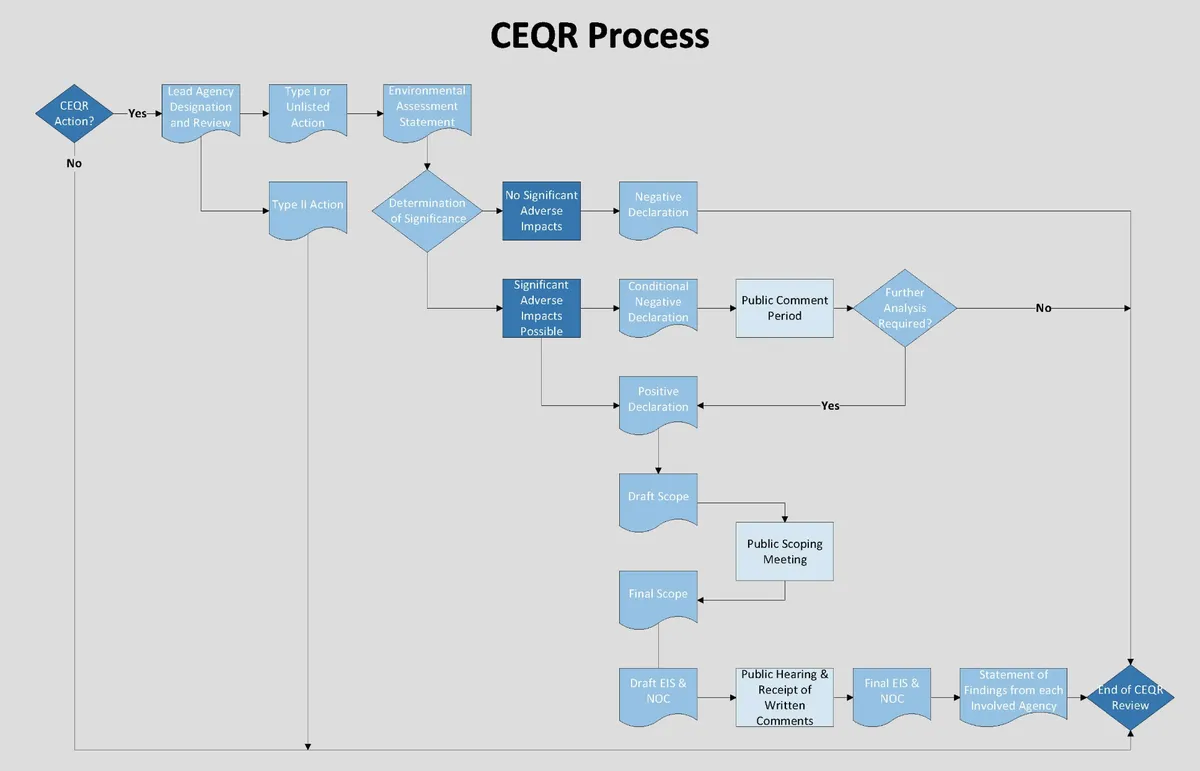
Here is a screengrab of the CEQR flowchart.
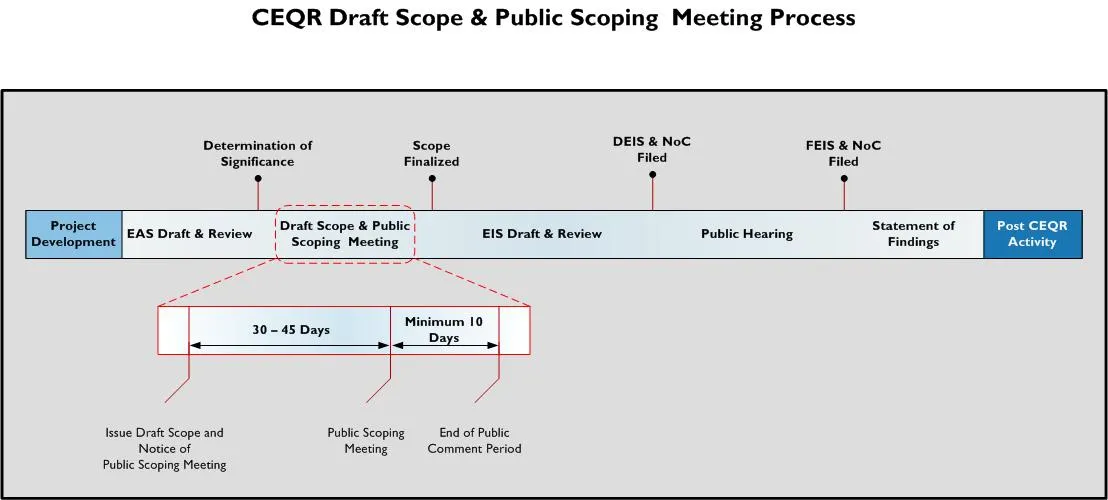
Scoping procedure
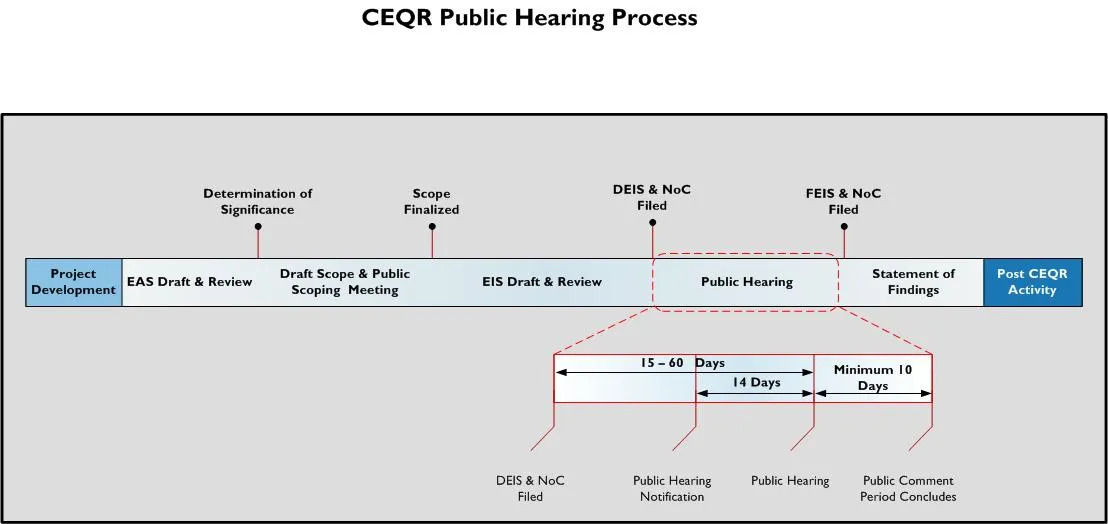
EIS procedure
SEQR & CEQR Differences
Differences in the CEQR procedure vs SEQR:
Uses an Environmental Assessment Statement (EAS), not EAF.
Adds additional scoping requirements see chapter 1 page 11 or pdf page 18
Promotes the use of the technical manual when conducting reviews (SEQR does not have a similarly detailed manual) with strict, quantitative methodologies; see chapter 3 of the manual for the intro to how to use it.
Biggest substantial technical differences assessed include shadows, urban design and visual resources v aesthetic resources, neighborhood character v community character, less emphasis on natural resources, no light/odor dedicated sections - only noise, more specific land use/zoning/public policy section since it is city specific, sanitation services, more specific on GHG emissions
Actions are defined as either 1. localized site-specific or small area, and 2. generic (citywide or neighborhoodwide)
Provides guidance on LA selection see chapter 1 page 6, pdf page 14. Depending on project type, the LA will be established as follows:
- Where only one city agency is involved in a proposed project, that agency shall be the lead (62 RCNY 5-03(a)).
- Where more than one agency is involved, a single lead agency is usually selected. Exceptions include legislative action, where the City Council & the Office of the Mayor act as co-lead agencies, and situations where a City and state agency may act as co-lead agencies.
- ULURP with no city agent applicant (private), 197-a community-based plans, or zoning map/text changes means the City Planning Commission (CPC) will be Lead.
- The Office of Environmental Coordination (OEC) is a liaison for state and federally involved agencies with the City. They shall perform the functions assigned by the LA to assist the review if state/feds are involved.5
Determination of Significance must be made within 15 days post receipt of final docs v 20 days for SEQR.
For EIS, a public scoping meeting is required following a draft scope before final scope.
When the scoping period starts, the issuance of the draft and Notice of public scoping meeting (mandatory, unlike SEQR) must occur, starting a 30-45 calendar day review. Once the public scoping meeting is held, there is a mandatory min 10 calendar day period for public comment.
Once the DEIS and NOC are filed (usually takes anywhere from 6-18 months to prepare), a 15-60 calendar period starts for review and filing of a public hearing notice. A PH cannot occur before 14 days after the filing. A min 10 calendar day public comment period follows the PH.
FEIS and NOC filed within 30 calendar days following DEIS, aka the end of the PH phase. SEQR has a wider 45-60 calendar day window.
Public Input For CEQR, the EAS results determine whether a project requires a public notice and comment period. There are two instances when public notice and comment apply: 1) after the issuance of a conditional negative declaration, & 2) after the issuance of a positive declaration (when a project requires an EIS to be prepared).
If the lead agency issues a conditional negative declaration for a project, the public is notified and has 30 days in which to comment. If the lead agency issues a positive declaration for your project, there are two opportunities for the public to participate: a public comment period and a scoping meeting on the draft scope and a public comment period and hearing on the draft EIS.6
SEQR does not require a PH.
The SEQR LA must provide a reasonable opportunity for the public and other interested agencies to participate in the draft scoping process. The DEC suggests that a minimum 20 calendar day period for public review. Public participation can be accomplished by meetings, exchanges of written material, or other methods. There is a SEQR public comment period following the filing of the Notice of Completion of a Draft EIS, which must be a minimum of 30 days, during which all concerned parties are encouraged to offer their comments to the lead agency. The comment period must continue at least 10 days following the close of a public hearing, if one is held.7
Recent Reforms
SEQR Reforms:
ULURP
When is it triggered
Procedure
Reforms
If you work in a related field to what is detailed herein, please let me know if I forgot something once I get my contact page up and running! There is a LOT to forget, lol. (: